
Westmoreland County Projected Release Dates
A projected date is an agency's current calculation of when a custody event could end if the assumptions behind it remain true. An eligibility date is the first point at which a decision-maker may consider a form of release. Neither is the same as the actual date and time a person crosses the gate or leaves one agency's custody. In Pennsylvania, this distinction matters because a minimum term can open parole eligibility while the maximum term sets the outer sentence boundary.
Westmoreland County Prison holds both people awaiting court action and people serving or otherwise detained on county matters. A pretrial detainee has no sentence from which to compute a projected end date. Bail may lead to release only after payment, surety paperwork, conditions, and prison processing are complete. A detainer can instead send the person to another authority. For a county sentence, the sentencing order, credit for time served, concurrent or consecutive terms, and county parole authority all affect the result.
- Minimum
- The court-set point before which the Parole Board generally cannot grant state parole.
- Maximum
- The outer limit of an indeterminate sentence, subject to the controlling record and law.
- Detainer
- A hold or request from another authority that may change where the person goes next.
- Actual release
- The recorded date and time one agency ended that custody episode.
Westmoreland County DOC Release Fields
The reviewed PA DOC Inmate/Parolee Locator does not show a field called Projected Release Date, Tentative Release Date, Minimum Date, or Maximum Date. This is a crucial local search limit. The application separates current inmates from Department Supervised Individuals. On the supervised side, a Release Date is a past date of release to state supervision. It must not be recast as a future estimate.
The locator is still useful for deciding whether a person moved from Westmoreland County custody into state jurisdiction or later entered state parole. A current state-inmate result points to a transfer or state sentence, not release to the community. A supervised-person result with a Release Date can support release to parole, but not final discharge. A former state prisoner who has completed supervision may no longer appear because the tool describes current jurisdiction and current supervision, not a permanent historical archive.
The official Pennsylvania locator shows the search choices captured below.
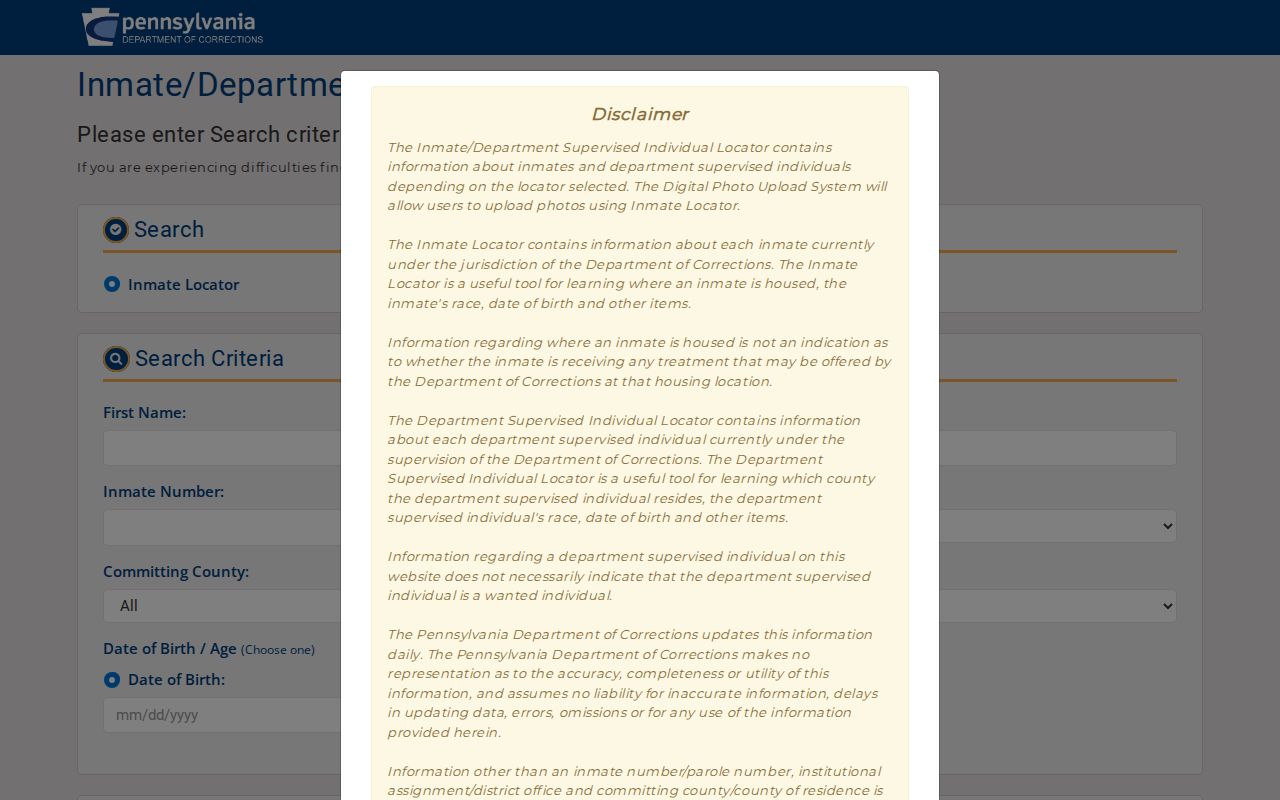
The screen helps identify current state custody or supervision, while an official future-date calculation must come from the sentence and agency records.
Note: Pennsylvania's public Release Date field refers to release to supervision, not a future projected date for a current inmate.
Find a Westmoreland County Release Date
The search route changes with custody type. Start with the sentencing court and the last known facility. A county booking number is useful for Westmoreland County Prison, while a PA DOC number is useful after a state transfer. Record both when they exist. A broad web search cannot replace these identifiers or an agency computation.
- Check the Westmoreland County current-inmate tool to determine whether the named booking is still reported in county custody. Absence alone does not prove release.
- Open the Pennsylvania UJS Case Search and read the Westmoreland County docket for the sentence, bail action, credit, and later orders.
- For a county sentence, ask Westmoreland County Prison for the existing time-computation or release record tied to that booking.
- For a state sentence, check both sides of the PA DOC locator to identify current state custody or state supervision.
- Request the final sentence-status and time-computation record from PA DOC when the public locator does not supply the needed dates.
- Confirm the actual release with the facility, PA SAVIN notice, supervised-person record, or final release record. Name any receiving custodian if the event was a transfer.
The full named-person workflow, including county, state, court, federal, and immigration channels, is available through the Westmoreland County released inmate search. For this date question, keep the inquiry narrow: what is the sentence source, what date did the responsible agency compute, and has the release actually occurred?
Westmoreland County State Release Terms
Pennsylvania uses an indeterminate sentencing framework for the relevant state prison terms. Under 42 Pa.C.S. §9756(b), the sentencing court sets a maximum and a minimum that generally may not exceed one-half of the maximum. The minimum is not an exit date. It is a point tied to parole eligibility.
Under 61 Pa.C.S. §6137(a), the Pennsylvania Parole Board generally cannot parole a person before the minimum unless another law applies. Life and death sentences are excluded from Board parole. Reaching the minimum lets the Board consider a release, but no law makes a favorable decision automatic. The Board may grant or refuse parole, and a refusal can identify a later review month.
Even a grant is one stage. An approved home plan, conditions, institutional processing, and detainers may remain. The Board Action proves the decision. PA DOC's actual-release record proves the later custody event. If the person is released to a detainer, the correct description is release by PA DOC to another custodian, not return to the community.
Westmoreland County Release and 85%
The Pennsylvania Parole Board expressly rejects the claim that state prisoners must serve 85 percent of their maximum sentence before parole. That generic rule should not be used to estimate a Westmoreland County case. Pennsylvania's court-set minimum and maximum, valid credit, aggregated terms, eligibility rules, Board decision, release plan, conditions, and detainers form the real path.
The official Pennsylvania parole process explains the state's rule.
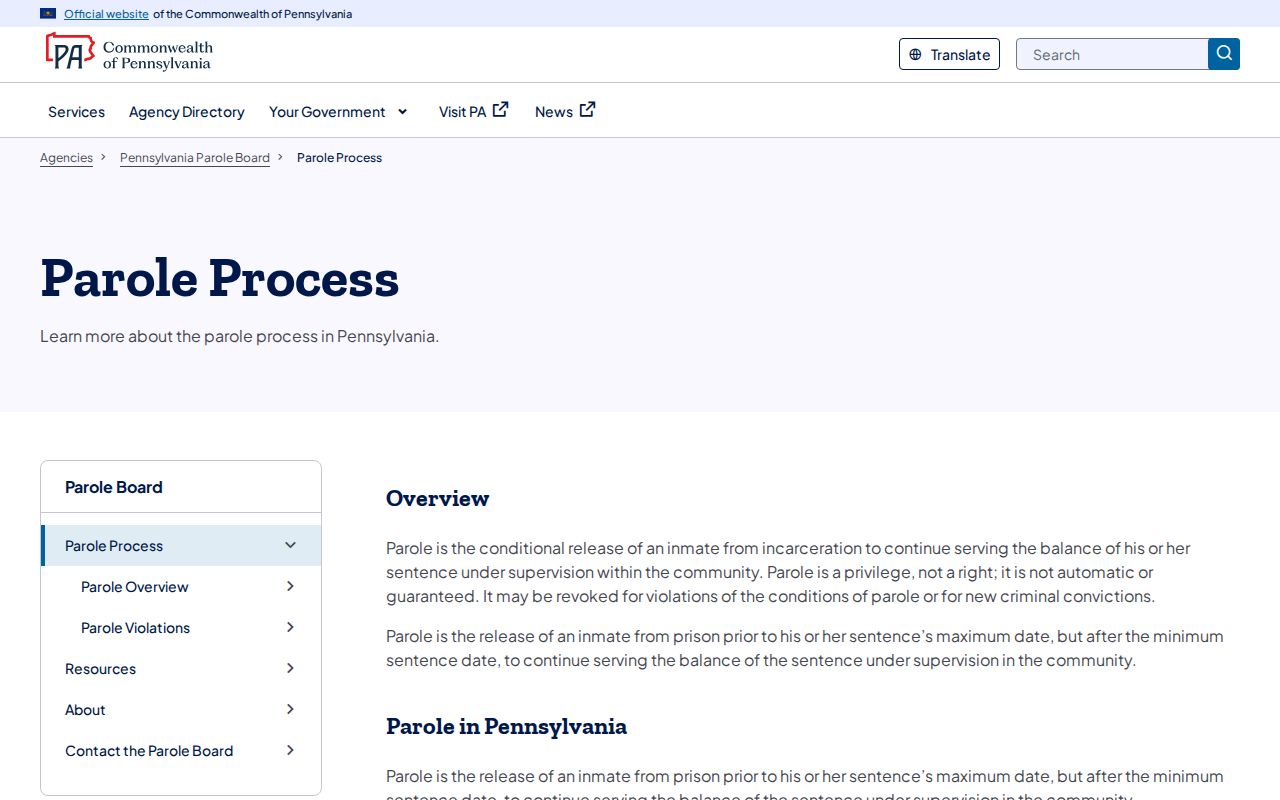
This official page corrects the common 85-percent shortcut and directs attention back to the minimum term and Board process.
A percentage copied from another state can produce a false date. So can dividing a maximum term by an assumed formula. Use the sentencing order and official time computation instead. If the court later corrects the sentence or awards more credit, the agency calculation may change.
Westmoreland County RRRI Release Eligibility
Pennsylvania does not use a universal day-for-day good-time schedule that shortens every PA DOC sentence. The main early-eligibility mechanism identified in the research is the Recidivism Risk Reduction Incentive, or RRRI. Under 61 Pa.C.S. §4505(c), an eligible sentence includes ordinary minimum and maximum terms plus an RRRI minimum. The statutory fraction is three-fourths when the ordinary minimum is three years or less, and five-sixths when it is more than three years, with rounding and aggregation rules.
Those fractions are not a safe public calculator. An ineligible part of an aggregated sentence can make the combined sentence ineligible. Section 4503 includes exclusions based on specified violent histories, weapon or firearm enhancements, crimes of violence and certain other personal-injury offenses, designated sexual and child-abuse-material offenses, registration-triggering offenses, drug trafficking, and pending disqualifying charges. The full record controls.
RRRI release also remains conditional. Section 4506 requires assessment and program-plan steps, program completion, good conduct, an adequate reentry plan, set conditions, notice, and continued certification. A person reaching an RRRI minimum is not thereby proved released. PA DOC should confirm both eligibility and the actual event.
Note: RRRI is an eligibility path for qualifying state sentences, not a county-jail good-time formula or a guaranteed release date.
Westmoreland County Jail Release Computation
A county sentence needs a county-specific reading. Do not apply RRRI or a state-prison shortcut to Westmoreland County Prison. Start with the Common Pleas sentencing order. Identify credit for time served, the minimum and maximum terms if stated, whether multiple terms run at the same time or one after another, and any county parole terms. Then ask the prison for its existing computation record.
A person awaiting trial has a different path. There is no sentence-based projected date to compute. Release may follow bail, recognizance, dismissal, a court order, or another event. Westmoreland County's bail instructions warn that electronic payment does not itself guarantee release because surety paperwork and all conditions must be finished. A separate detainer can block a return to the community even after the local court authorizes release.
For a time-served order, the docket shows legal authority, not the physical exit time. Westmoreland County Prison may still need to check another case or hold. Use the county's current-inmate route, PA SAVIN, and the prison record to confirm completion. This keeps a court event, a projected processing point, and an actual release from being merged into one unsupported date.
Why Westmoreland County Release Dates Change
A projected date is based on the current sentence and custody record. A later legal or administrative event can alter the computation or the route out. Some changes move eligibility. Others leave the legal date intact but delay physical release or change the receiving custodian.
| Factor | Effect on the date or release | Best record |
|---|---|---|
| Sentence correction | Changes the controlling minimum, maximum, or term structure | Court order and new agency computation |
| Time credit | Can alter the computed term when officially awarded | Docket and sentence-status record |
| Aggregation | Combines terms and may affect eligibility or RRRI treatment | PA DOC computation |
| Program or conduct status | Can affect conditional RRRI eligibility or certification | PA DOC sentence-status record |
| Parole decision | A grant advances the process; a refusal can set later review | Final Board Action |
| Home plan or conditions | Can prevent a grant from becoming an immediate release | Board and institutional release records |
| Detainer | May cause transfer to another agency instead of community release | Release disposition and receiving-agency record |
Do not describe misconduct as automatically adding a fixed number of days unless the official record says so. Pennsylvania's mechanisms are not a simple good-time debit chart. Ask the agency for the current calculation and the reason for any change.
Request Westmoreland County Release Computations
When the public locator has no future date, the direct route is an existing agency record. For a county sentence, use Westmoreland County's Open Records Request process and identify the person by full name, date of birth, booking number, and the custody episode. Ask for the releasable time-computation and release record rather than asking staff to calculate a date in response to a broad question.
For a state sentence, PA DOC accepts Right-to-Know requests through its official records procedure. A focused request can seek the final sentence-status or time-computation record, actual release or discharge record, release disposition, and final public Board Action if held. The DOC RTKL Office is at 1920 Technology Parkway, Mechanicsburg, PA 17050; its published phone is 717-728-7763.
The Pennsylvania Right-to-Know Law generally gives an agency five business days to respond, with a written extension allowed on statutory grounds. Exemptions, privilege, another law, or a court order may limit disclosure. Court records instead use the Unified Judicial System and local Rule 509 channels. A narrow request tied to an existing record gives the office a clear, auditable task.
Confirm Westmoreland County Actual Release
Final confirmation comes from the agency that ended custody. For Westmoreland County Prison, check the current-only roster, use PA SAVIN for a reported custody change, and call the prison at 724-830-6000 with the booking number. Ask whether the booking remains active, whether an actual release was recorded, and whether the event was a transfer. For a state prisoner, pair the Board Action with the PA DOC supervised-person result and the actual release record.
PA SAVIN can report a release or move, but the notification system does not promise a full historical record, a precise reason, or a fixed retention period. A move can be a transfer. If an alert is helpful, the Westmoreland County VINELink check explains the named-person search and registration steps. Always use the source agency for the final date and destination.
Note: Record the system and date checked so a later change can be traced without treating an old screen as current fact.